
Last Updated: October 22, 2026
Quick Summary
Homemade flower food recipes use just sugar, citric acid, and bleach to extend cut flower life from five to seven days to one or two weeks. The basic recipe for one quart of water is one teaspoon sugar, one-quarter teaspoon bleach, and two to three drops of lemon juice, mixed into room-temperature tap water.
- Change water and refresh your homemade flower food mixture every two to three days for best results.
- Cut stems at a 45-degree angle and remove lower leaves before arranging to prevent bacterial growth.
- Use only unscented household bleach at 5.25% sodium hypochlorite, measured carefully with a measuring spoon.
- The basic recipe works for roses, carnations, tulips, sunflowers, and mixed bouquets with few exceptions.
- Flowers drink most actively in the first 24 hours after arrangement, making that initial flower food crucial.
Table of Contents
- Why Make Your Own Homemade Flower Food
- Essential Ingredients for Homemade Flower Food
- Basic Homemade Flower Food Recipe
- Sugar and Vinegar Flower Food for Extended Bloom
- How to Make Cut Flowers Last Longer
- How Often to Change Flower Water and Refresh Your Mixture
- Common Mistakes to Avoid When Making Flower Food
- Frequently Asked Questions
Why Make Your Own Homemade Flower Food
Most cut flowers last five to seven days in plain water, but a simple homemade flower food recipe can extend that bloom by days, sometimes weeks.
Commercial flower food works, but kitchen ingredients do the same job: sugar feeds blooms, citric acid lowers pH, and a touch of bleach stops bacterial growth.
At Charmed Valley Farm, we believe in simple, intentional choices. When you make your own homemade flower food recipes, you know every ingredient, with no mystery and no unnecessary chemicals.
Plus, homemade solutions cost pennies per batch. If you arrange flowers regularly, making your own DIY flower food becomes second nature.
Essential Ingredients for Homemade Flower Food
You need just four things. That's it.
Sugar feeds the cut flowers. Blooms need carbohydrates to open fully and maintain color; a teaspoon or two per vase makes a visible difference.
Citric acid (or lemon juice) lowers the pH of your vase water, helping flowers absorb water more efficiently. Fresh lemon juice works perfectly if you don't have citric acid.
Bleach stops bacterial growth that clogs stems and blocks water uptake. A quarter teaspoon per quart keeps water clean without harming blooms.
Water is your base. Use room-temperature tap water; if yours is heavily chlorinated, let it sit a few hours before mixing your homemade flower food recipe.
Basic Homemade Flower Food Recipe
This is the foundation. Master this, and you can adjust everything else.
For a standard vase (about one quart of water):
- 1 teaspoon sugar
- 1/4 teaspoon household bleach (unscented, 5.25% sodium hypochlorite)
- 2-3 drops of lemon juice (or 1/8 teaspoon citric acid)
Stir into room-temperature water until the sugar dissolves. That's your DIY flower food ready to go.
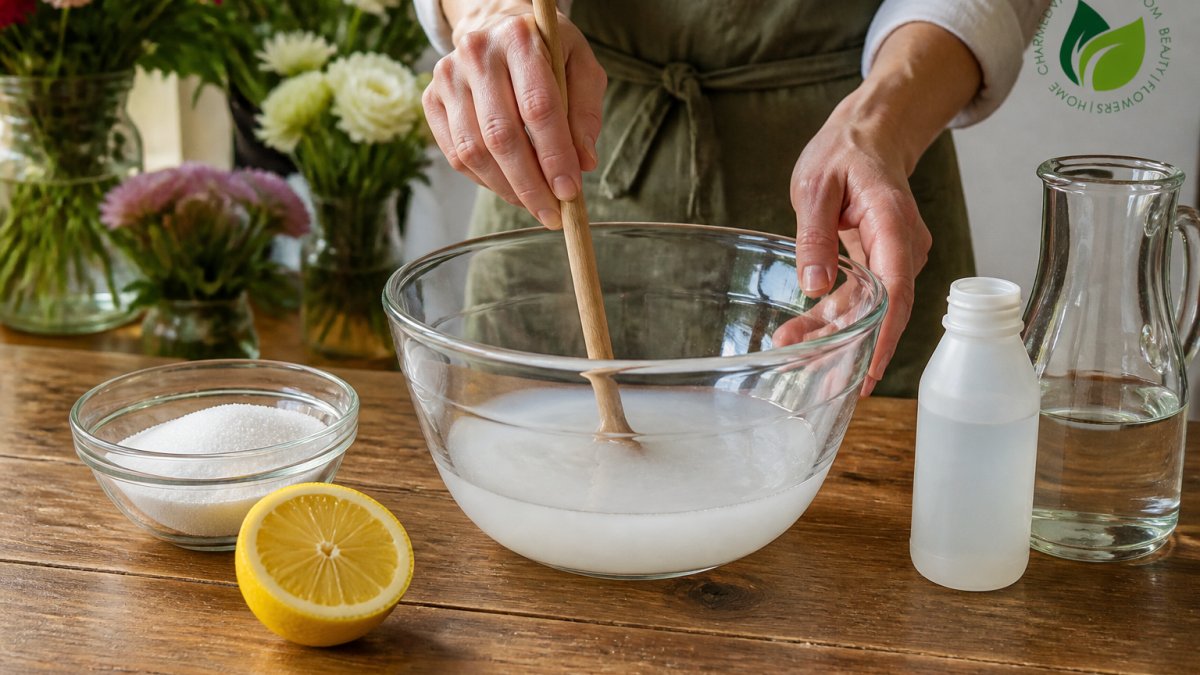
Sugar provides energy, bleach prevents rot, and acid helps stems drink, replicating commercial flower food recipes with ingredients you recognize.
Scaling the Recipe Up or Down
One quart suits a single mixed bouquet. For larger jobs, scale linearly and measure carefully, because bleach is the one ingredient where more is not better.
- Pint (2 cups): 1/2 teaspoon sugar, 1/8 teaspoon bleach, 1-2 drops lemon juice or a pinch of citric acid.
- Quart (4 cups): 1 teaspoon sugar, 1/4 teaspoon bleach, 2-3 drops lemon juice or 1/8 teaspoon citric acid.
- Gallon (16 cups): 4 teaspoons sugar, 1 teaspoon bleach, 1/2 teaspoon citric acid or about 1 tablespoon lemon juice.
- Bucket (5 gallons): 1/4 cup plus 1 tablespoon sugar, 1 1/4 teaspoons bleach, 2 1/2 teaspoons citric acid or about 5 tablespoons lemon juice.
Can You Store a Dry Mix or Prepared Liquid?
A dry mix of sugar and citric acid stores well in a sealed jar in a cool, dark cabinet for several months; keep the scoop dry. Never pre-mix bleach into a dry blend; add it only when you mix the liquid.
Prepared liquid is best used within 24 hours, since bleach loses potency and sugar water invites bacteria. If you must mix ahead, refrigerate the sugar-and-acid portion and add bleach just before use.
Which Flowers Respond Differently
One recipe does not suit every stem. The basic quart recipe works well for roses, carnations, tulips, sunflowers, and standard mixed bouquets, with a few exceptions:
- Woody stems such as lilac, hydrangea, and flowering branches benefit from a fresh angled cut plus a vertical slit or light crush at the base so water can enter. Hydrangea in particular may need the extra step of dipping the stem ends in boiling water for a few seconds before arranging.
- Daffodils exude a sap that harms other flowers. Condition them in their own vase for several hours, then rinse the stems before mixing them into a bouquet.
- Tulips continue to grow in the vase and are sensitive to too much sugar, which can push soft, floppy growth. Use the lower end of the sugar range for tulips.
- Delicate blooms such as sweet peas and poppies do best with a weaker sugar solution and cooler water.
Change your water every two to three days using this same mixture.
Sugar and Vinegar Flower Food for Extended Bloom
Some florists swear by vinegar instead of lemon juice: it's acidic, shelf-stable, and you probably have it already.
For a one-quart vase:
- 1 teaspoon sugar
- 1/4 teaspoon bleach
- 1 tablespoon white vinegar
The vinegar creates a more acidic environment than lemon juice alone.
Flowers evolved in slightly acidic soil, and your vase becomes a temporary soil substitute. The lower pH signals the stem to absorb water efficiently.
The trade-off: vinegar has a smell. Some don't mind it; others prefer the neutral scent of lemon juice. Both work equally well for keeping cut flowers fresh.
How to Make Cut Flowers Last Longer
Beyond the flower food itself, technique matters enormously.
Start with clean stems. Cut about an inch off the bottom at a 45-degree angle with sharp scissors right before placing flowers in your prepared vase.
Remove lower leaves. Foliage below the waterline rots and introduces bacteria, so strip leaves from the bottom two inches of each stem.
Use a clean vase. Rinse it with hot water before filling; bacteria from a previous arrangement will shorten the life of your new blooms.
Place flowers in a cool spot. Away from direct sunlight, heat sources, and ripening fruit, whose ethylene gas accelerates aging.
Keep the water level consistent. Check daily and top off with plain water between full changes.
Change the entire mixture every two to three days. Fresh water with fresh homemade flower food beats stale water every time. Re-cut the stems at that 45-degree angle when you change it.
How Often to Change Flower Water and Refresh Your Mixture
The rhythm is simple: every two to three days.
On day one, arrange your flowers in your prepared homemade flower food mixture.
That's your cue to empty and rinse the vase, mix a fresh batch of your DIY flower food recipe, re-cut the stems, and rearrange.
Repeat this cycle for as long as the flowers look good. Most arrangements last one to two weeks with consistent care.
If flowers look droopy before day three, change the water sooner; if they're thriving on day four, wait another day.
Stale water kills flowers faster than anything else: bacteria multiply, stems clog, and water absorption drops. Fresh water with fresh food resets the clock every time.
Setting Realistic Expectations
Plain tap water typically gives cut flowers five to seven days. A well-made homemade food plus clean-vase habits commonly adds several days. Delicate blooms such as sweet peas, poppies, and dahlias are shorter-lived no matter what you add, so judge results against the flower type rather than a single number. Keep a simple note of the date you arranged each bouquet and how many days it lasted; after a few cycles you will know which recipes and flowers pair best in your home.
Troubleshooting: Cloudy Water, Slimy Stems, and Drooping Blooms
Cloudy water means bacteria have outgrown the bleach. Empty the vase, scrub it with hot soapy water, rinse, and mix a fresh batch rather than topping off.
Slimy stems signal decaying tissue below the waterline.
Drooping blooms with firm stems often mean air has entered the stem.
Drooping blooms with soft, mushy stems usually mean the stem has rotted and will not recover. Remove those stems so they do not spoil the rest of the arrangement.
Water that smells off is a sign the sugar is feeding bacteria faster than the bleach can control them.
Water Quality and Vase Hygiene
Recipe alone will not save a dirty vase. Wash containers with hot soapy water between arrangements, scrubbing the inside walls where biofilm hides. Use room-temperature water, and if your tap water is heavily chlorinated, let it stand a few hours before mixing. Change the water fully rather than topping off, and keep prepared solution and bleach out of reach of children and pets.
Common Mistakes to Avoid When Making Flower Food
Using too much bleach. A quarter teaspoon per quart is enough; more damages delicate stems. Measure carefully.
Forgetting the sugar. Flowers need carbohydrates; without them, they fade and wilt faster.
Using hot water. This damages the vase life immediately. Stems can't absorb hot water efficiently.
Mixing in a dirty vase. Your perfect flower food recipe can't overcome bacteria already in the vase.
Letting stems stay in old water too long. The moment water clouds or smells off, change it.
Adding random ingredients. Honey, aspirin, and vodka are unnecessary and introduce unpredictable variables.
Keeping cut flowers fresh doesn't require expensive additives or complex chemistry.
Frequently Asked Questions
How do you make homemade flower food?
Mix one tablespoon of sugar, one teaspoon of lemon juice or citric acid, and one-quarter teaspoon of bleach into one quart of room-temperature water. Stir until the sugar dissolves completely. This homemade flower food provides nutrients (sugar), lowers pH to prevent bacterial growth (acid), and keeps water clear (bleach). Change the mixture every 3-5 days or when it becomes cloudy. This basic recipe works for most cut flowers.
What is the best homemade flower food recipe for cut flowers?
The sugar and vinegar flower food recipe is highly effective: combine one tablespoon of sugar, two tablespoons of white vinegar, and one-quarter teaspoon of bleach per quart of water. The vinegar lowers pH more gradually than lemon juice, creating a gentler environment for delicate blooms. For roses and woody stems, increase the sugar to one and one-half tablespoons. Always use room-temperature water and dissolve ingredients thoroughly before adding stems.
How often should you change flower water and refresh your homemade flower food?
Change the vase water and refresh your homemade flower food mixture every 3-5 days, or immediately if the water becomes cloudy or develops an odor. Fresh water removes bacteria and dissolved stem debris that block water uptake. When you change the water, trim one-quarter inch from the stem ends at a 45-degree angle to expose fresh vascular tissue. Each time you refresh, prepare a new batch of flower food rather than reusing the old mixture. This schedule keeps cut flowers fresh and extends their vase life significantly.
Can sugar and vinegar keep flowers fresh as well as commercial flower food?
Sugar and vinegar flower food provides the core nutrients and antimicrobial protection that commercial preservatives offer. Sugar feeds the bloom, vinegar maintains proper pH, and bleach inhibits bacterial growth. However, commercial formulations may include additional ingredients like biocides and hydrating compounds that some flowers respond to more strongly. For best results, pair your homemade mixture with proper stem care, fresh water changes, and cool storage.