
Table of Contents
- What Farm Fresh Beauty Products for Acne Should Actually Do
- Why Botanical Skincare for Acne Works (and When It Doesn't)
- The Charmed Valley Farm Flower Face Line: A Closer Look
- How to Choose Natural Skincare for Breakouts
- Building a Natural Acne Treatment Routine That Sticks
- What Farm Fresh Beauty Products for Acne Can't Do
- Frequently Asked Questions
Last Updated: September 13, 2026
What Farm Fresh Beauty Products for Acne Should Actually Do
Farm fresh beauty products for acne should do three things: calm active breakouts, support the skin barrier, and avoid harsh ingredients that trigger rebound oil. This guide covers what botanical acne care can realistically deliver, where it falls short, and how to build a routine that lasts.
Acne is multifactorial: sebum regulation, pore congestion, dead skin cell removal, and inflammation. No single botanical extract fixes all four. Well-formulated natural skincare supports the skin's own repair processes while you address the drivers.
The American Academy of Dermatology notes that acne affects people well into their 50s, which matters if you assumed breakouts were a teenage problem you'd outgrown. American Academy of Dermatology acne resource center
Below: how to read a farm-to-skin label, which ingredients earn their place, and how the Flower Face line fits reactive, mature skin.

Why Botanical Skincare for Acne Works (and When It Doesn't)
Botanical skincare for acne works when the formula targets inflammation and barrier repair rather than stripping oil. It fails when a brand swaps proven actives for decorative plant extracts.
The mechanism matters. Salicylic acid, a beta-hydroxy acid from willow bark, dissolves the keratin plugs that block pores (peer-reviewed research). Niacinamide (vitamin B3) regulates sebum and reduces redness (PubMed). Bisabolol, from chamomile, calms irritation. All three are studied, plant-derived ingredients.
What botanical formulas generally don't do is deliver the resurfacing of retinoids or the bactericidal punch of benzoyl peroxide. If your acne is cystic or widespread, a natural routine complements dermatological care, it doesn't replace it.
The Charmed Valley Farm Flower Face Line: A Closer Look
The Flower Face Skincare line is a small-batch, preservative-free system built around flower hydrosols and cold-pressed botanical oils, a two-step routine, not a ten-product regimen.
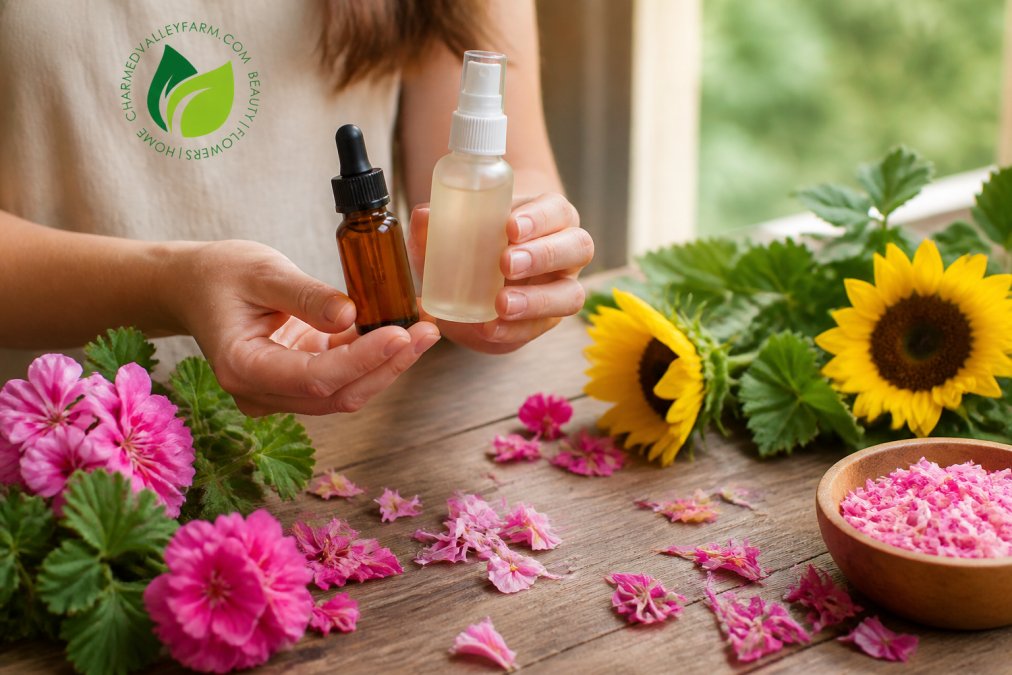
Flower Water Face Toner
The Flower Water Face Toner is a distilled hydrosol with traces of lavender, clary sage, amaranth, yarrow, and honeysuckle essential oils. It costs $45.00 for a 3.4 oz atomizer.

It clarifies and balances oils without the alcohol sting that leaves reactive skin tight. Spritz after cleansing and before serum, or midday as a cooling reset.
Flower Oil Face Serum
The Flower Oil Face Serum is a cold-pressed sunflower oil base infused with rosehips, wild rose geranium, and raspberry leaves. It's also $45.00 for a 1 oz dropper bottle.

Reported results include easing acne, reducing inflammation, balancing oils, and decreasing redness. Rosehip oil is rich in linoleic acid, and lower linoleic acid levels in sebum are associated with more congested pores. One full dropper massaged into damp skin at night is the intended dose.
Flower Face Duo
The Flower Face Duo costs $85.00, a saving over the two bottles. The toner prepares and calms; the serum seals in moisture and delivers botanical actives, the sensible entry point for beginners.
| Product | Size | Price | Role in Routine | Best For |
|---|---|---|---|---|
| Flower Water Face Toner | 3.4 oz | $45.00 | Clarify, prep, refresh | Reactive skin needing calm |
| Flower Oil Face Serum | 1 oz | $45.00 | Hydrate, repair, balance | Dry or combination acne |
| Flower Face Duo | Both | $85.00 | Complete two-step system | First-time buyers |
How to Choose Natural Skincare for Breakouts
Choosing natural skincare for breakouts comes down to four filters: ingredient transparency, non-comedogenic oils, no drying alcohols, and honest claims. Run every candidate through this checklist:
- Full ingredient list published, if the brand hides behind "proprietary botanical blend," walk away
- No denatured alcohol or fragrance in the first five ingredients
- Non-comedogenic carrier oils, sunflower, rosehip, and jojoba rate low; coconut oil rates high
- Preservative system disclosed, preservative-free formulas need a stated shelf life and storage guidance
- No "cures acne" language, cosmetic products cannot legally make drug claims
- Batch or harvest date visible, small-batch botanical products lose potency over time
The greenwashing question is fair. A brand claiming "chemical-free" while listing phenoxyethanol contradicts itself, water is a chemical. What matters is whether the formula avoids what you're dodging: synthetic fragrance, drying alcohols, parabens, and petroleum derivatives.
Building a Natural Acne Treatment Routine That Sticks
A natural acne treatment routine works best when it's short enough to repeat nightly and specific enough that every product earns its place. Consistency beats complexity, especially for skin over 40. The layer most guides skip: which "farm-fresh" botanicals are actually non-comedogenic, and which quietly clog pores despite the green label.
The Acne-Safe Ingredient Dictionary
Before you build a routine, learn to read the label. Comedogenic ratings run from 0 (won't clog pores) to 5 (highly likely to clog), based on published dermatology scales, and apply to botanical oils just as much as synthetic ones.
Low-comedogenic (0-2), generally safe for blemish-prone skin:
- Sunflower seed oil (0), high in linoleic acid, which acne-prone sebum tends to be low in; a common carrier for botanical serums
- Rosehip seed oil (1), rich in linoleic and linolenic acids plus trans-retinoic acid precursors; often cited for fading post-inflammatory marks
- Jojoba oil (2), a liquid wax ester that mimics human sebum, so it can help regulate oil rather than add to it
- Squalane (1), an olive- or sugarcane-derived emollient that mimics the skin's own lipid; lightweight and rarely triggers congestion
- Hemp seed oil (0), high in linoleic acid; common in blemish-focused facial oils
- Neem oil (1-2), traditionally used for antibacterial and anti-inflammatory properties; strong scent, so usually diluted
Moderate-comedogenic (3), use with caution on acne-prone areas:
- Sweet almond oil (2-3), fine for most, but can congest the T-zone in oily skin
- Apricot kernel oil (2-3), similar profile; patch-test before full-face use
- Avocado oil (3), rich and heavy; better for dry cheeks than an oily forehead
High-comedogenic (4-5), avoid on active breakout zones:
- Coconut oil (4), the most common culprit in "natural" products that break people out
- Cocoa butter (4), occlusive and heavy; fine for body, risky for the face
- Wheat germ oil (5), rarely used on facial skin for this reason
- Marula and shea butter (2-3), often marketed as "light," but shea in particular can congest acne-prone skin
A practical rule: if a botanical oil appears in the first five ingredients and rates 3 or higher, treat it as a body product, not a face product.
A Four-Step Evening Sequence
A sequence that pairs well with botanical formulas and respects the ratings above:
- Cleanse with a gentle, non-stripping wash. Warm water, fingertips, 30 seconds. Avoid sulfates like sodium lauryl sulfate, which strip the barrier and trigger rebound oil.
- Tone with a hydrosol spritz while skin is damp. Alcohol-free hydrosols (lavender, rose, chamomile) beat astringent toners built on denatured alcohol.
- Treat with one active, low-strength salicylic acid (0.5-2%) for pore decongestion, or a botanical serum on sunflower or rosehip oil. Don't layer both when starting out.
- Moisturize with a non-comedogenic oil or cream to seal the barrier overnight. Oily skin often needs only a squalane moisturizer; dry, reactive skin can finish with rosehip or sunflower serum.
Morning stays minimal: rinse, tone, moisturize, sunscreen. Sunscreen matters more than most acne guides admit, post-inflammatory hyperpigmentation darkens with UV exposure and can outlast the breakout by months. Mineral SPF 30+ with zinc oxide suits reactive skin, since zinc has mild anti-inflammatory properties.
Layering Rules for Sensitive, Acne-Prone Skin
For sensitive, acne-prone skin, introduce one product per two weeks. If your skin stings, flakes, or reddens within an hour, that product isn't for you regardless of the label. Layering rules:
- Thinnest to thickest. Hydrosol, then water-based serum, then oil, then cream.
- One active at a time. Salicylic acid and vitamin C on the same night is a common trigger for irritation.
- Don't stack exfoliants. A BHA toner plus a physical scrub plus a retinol is the fastest route to a compromised barrier.
- Patch-test on the jawline, not the wrist, facial skin reacts differently than arm skin.
| Step | Product Type | Frequency | Watch For |
|---|---|---|---|
| Cleanse | Gentle non-stripping wash | Twice daily | Tightness after rinsing |
| Tone | Hydrosol or alcohol-free toner | Twice daily | Stinging or flushing |
| Treat | Botanical serum or BHA (0.5-2%) | Nightly, alternate if needed | Dryness, purging |
| Moisturize | Non-comedogenic oil or cream | Twice daily | Congestion, milia |
| Protect | Mineral SPF 30+ | Every morning | Breakouts from heavy formulas |
What Farm Fresh Beauty Products for Acne Can't Do
Farm fresh beauty products for acne can't replace prescription treatment for moderate to severe acne, and any brand implying otherwise is overselling. Botanical formulas support the skin; they don't restructure a pore genetically prone to clogging. The gap most guides leave open: how natural actives compare to synthetic ones in mechanism and clinical evidence.
Natural vs. Synthetic Actives: What the Evidence Actually Shows
"Natural" and "scientifically validated" aren't opposing categories. Many of the most studied acne actives are plant-derived, then stabilized or standardized in a lab. What matters is formulation quality and dose, not origin story.
Where natural actives have real evidence:
- Salicylic acid, originally from willow bark and sweet birch, now typically synthesized for purity. This beta-hydroxy acid dissolves the keratin plugs blocking pores. OTC concentrations run 0.5-2%; it has decades of clinical support.
- Niacinamide (vitamin B3), studied for sebum regulation, redness reduction, and barrier support. Common at 2-5% in botanical and conventional formulas alike.
- Tea tree oil, compared in published research to low-concentration benzoyl peroxide for mild acne, with slower onset but better tolerability. Usually diluted to 5% or less.
- Azelaic acid, from grains like barley and wheat; studied for acne and post-inflammatory hyperpigmentation. OTC at 10%, prescription at 15-20%.
- Green tea polyphenols, studied for anti-inflammatory and sebum-regulating effects, usually as a supporting ingredient rather than a standalone treatment.
Where synthetic actives still lead:
- Benzoyl peroxide, bactericidal against Cutibacterium acnes at concentrations natural botanicals rarely match. It's the benchmark for inflammatory acne.
- Retinoids (tretinoin, adapalene), restructure the pore lining and normalize cell turnover. No botanical has replicated this mechanism at comparable strength. Adapalene 0.1% is available over the counter; tretinoin requires a prescription.
- Prescription antibiotics and hormonal therapies, reserved for moderate to severe or hormonal acne, and outside what any cosmetic product can legally claim to treat.
A common pattern in dermatology is combining both: a gentle botanical routine for barrier support and tolerability, plus a targeted synthetic active (adapalene, benzoyl peroxide, or a prescription retinoid) for the actual acne mechanism. That combination often outperforms either approach alone.
Three Limits Worth Knowing Before You Spend
- They won't clear cystic acne. Deep, painful nodules need dermatological intervention. Nodulocystic acne scars, and delay costs more than a dermatologist visit.
- They won't work overnight. Barrier repair and sebum regulation take four to eight weeks of consistent use. A brand promising visible clearing in a week is making a marketing claim, not a formulation one.
- They won't fix an over-aggressive routine. Scrubbing twice daily and layering acids can't be offset by any serum. Over-exfoliation damages the barrier, increasing inflammation and worsening acne, a cycle that looks like "nothing works" but is really "too much is happening."
When to Escalate Beyond Botanical Care
A few signals that natural skincare alone isn't the right tool:
- Painful, deep nodules or cysts that don't come to a head
- Scarring, pitting, rolling, or ice-pick marks forming after breakouts
- No improvement after 8-12 weeks of a consistent, non-irritating routine
- Sudden severe onset in adulthood, which can signal a hormonal or medical issue worth evaluating
Where natural formulas genuinely outperform: tolerability. If synthetic actives leave your skin red, peeling, and reactive, a gentler botanical approach may let you stay consistent long enough to see results. That consistency is the actual variable, and why a well-formulated botanical routine can beat a harsh one abandoned in week two.
Frequently Asked Questions
Are farm fresh beauty products for acne effective on hormonal breakouts?
Botanical formulas can calm inflammation and support the skin barrier, which helps with hormonal breakouts, but they work differently than prescription actives. Ingredients like rose geranium and sunflower oil reduce redness and balance oil without stripping skin. For deep cystic hormonal acne, a natural routine works best alongside guidance from a dermatologist. Many people use farm fresh beauty products for acne as their daily maintenance layer and see fewer flare-ups over time.
What should I look for in botanical skincare for acne?
Look for non-comedogenic oils, anti-inflammatory botanicals, and formulas free of synthetic fragrance and harsh alcohols. Cold-pressed sunflower oil, rosehips, and niacinamide are good signs. Avoid products listing mineral oil or heavy silicones high on the label. Charmed Valley Farm's Flower Face line uses small-batch distilled hydrosols and cold-pressed oils, which fits the criteria for botanical skincare for acne.
How do I start a natural acne treatment routine if my skin is sensitive?
Start with one product at a time. Begin with a gentle cleanser, then add a toner like Flower Water Face Toner ($45) to clarify and calm. After a week, introduce the Flower Oil Face Serum ($45) at night. Patch-test on your jawline first. A natural acne treatment routine built slowly lets you identify what helps and what irritates, which matters more for sensitive skin than stacking multiple actives at once.
Is farm-to-face skincare just marketing, or does it actually work for acne?
It depends on the brand. Some 'farm-to-face' labels are greenwashing with minimal botanical content. Real farm-to-face products list specific plant ingredients and their sources, use small-batch production, and avoid preservatives that mask low potency. Charmed Valley Farm's Flower Face Duo ($85) uses hydrosols from lavender, clary sage, and yarrow, which are part of its #Farm2Face philosophy.
How long before I see results from natural skincare for breakouts?
Most people notice reduced redness and calmer skin within two to three weeks of consistent use. Full improvements in texture and breakouts typically take six to eight weeks because skin cell turnover follows a roughly 28-day cycle. When you choose natural skincare for breakouts, consistency matters more than strength. Use the toner daily and the serum nightly, and take photos weekly so you can track changes objectively rather than relying on memory.