
Table of Contents
- Why Synthetic Chemicals in Beauty Products Matter
- How to Read Skincare Ingredient Labels
- Common Synthetic Chemicals Used in Cosmetics
- Ingredients to Avoid in Skincare for Sensitive Skin
- Natural vs. Synthetic Skincare Ingredients: What the Label Doesn't Say
- How to Use a Cosmetic Ingredient Checker
- Red Flags That Signal Hidden Synthetics
- Conclusion
- Frequently Asked Questions
Last Updated: October 17, 2026
Why Synthetic Chemicals in Beauty Products Matter
Most labels are written to sell, not to inform. That is the uncomfortable truth behind the clean beauty aisle. If you have ever stood in a store squinting at a bottle, wondering whether "fragrance" means flowers or a lab-made compound, you are not alone. This guide from Charmed Valley Farm walks you through how to identify synthetic chemicals in beauty products, step by step, so you can make choices that match your values and your skin.
Here is the core tension: a product can say "natural" on the front and still be built mostly from synthetic chemicals. The word "natural" has no legal definition in cosmetics. So the back label is where the truth lives, and reading it well is a skill worth learning.
Below, we show you exactly how to decode a label, spot common synthetics, and use free tools to check any ingredient in seconds.
How to Read Skincare Ingredient Labels
Ingredient labels follow a simple rule: what is listed first is present in the largest amount. Once you know the order, the label stops being a wall of Latin and starts reading like a recipe.
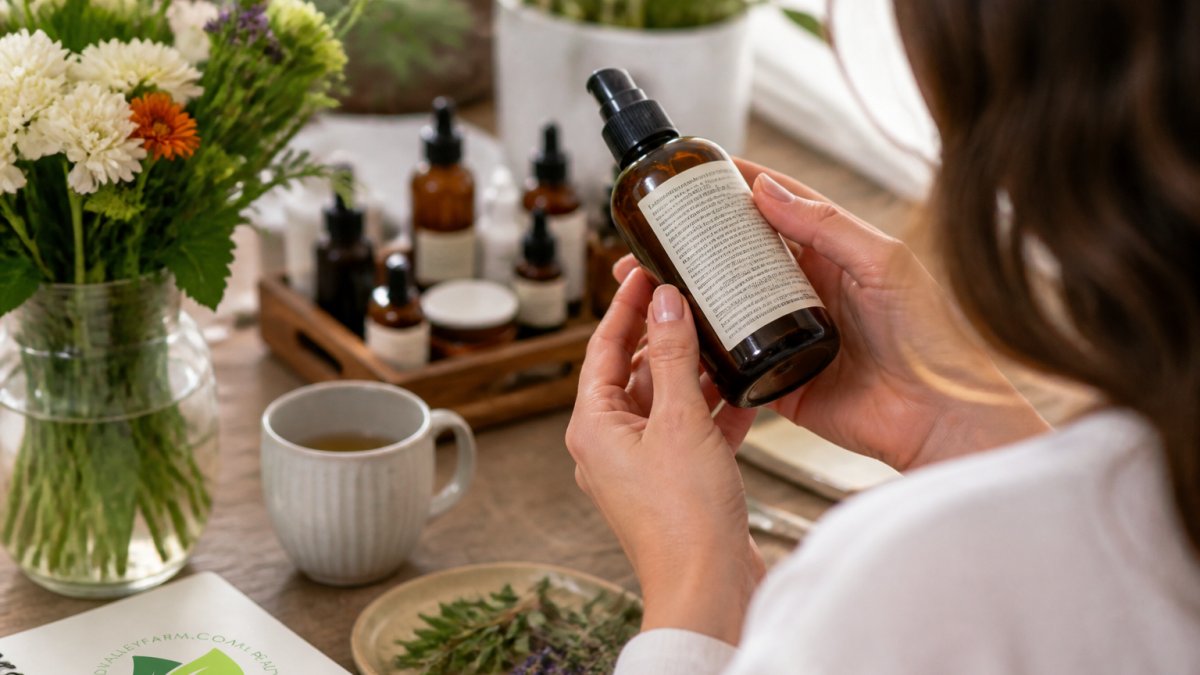
The Order of Ingredients Tells a Story
Ingredients appear in descending order by weight, down to one percent. Anything after that can be listed in any order. This is where brands hide tiny amounts of preservatives or fragrance. A common mistake is assuming a botanical name near the bottom means the product is plant-based. It often means the plant is a token sprinkle.
Scan the first five ingredients. If water, alcohol, or a synthetic silicone leads the list, the formula is not botanical at heart.
Decoding INCI Names and Hidden Fragrances
INCI stands for International Nomenclature of Cosmetic Ingredients. It is the standardized naming system used on labels, mixing Latin plant names with chemical names. So "butyrospermum parkii" is shea butter, and "tocopherol" is vitamin E.
The trickier word is "fragrance" or "parfum." Under current rules, a brand can group dozens of scent compounds under that single word without listing them. If you have sensitive skin, treat "fragrance" as a question mark, not a selling point.
Common Synthetic Chemicals Used in Cosmetics
Synthetic chemicals are lab-made compounds used to preserve, thicken, scent, or stabilize a product. They are not automatically harmful, but some are worth watching, especially for reactive skin.
Here are the ones we see most often:
- Parabens (methylparaben, propylparaben): preservatives that keep products from spoiling
- Phthalates: often hidden inside "fragrance" to help scent last
- Sodium lauryl sulfate (SLS): a foaming agent that can strip skin
- Synthetic silicones (dimethicone, cyclopentasiloxane): give a smooth, slippery feel
- PEG compounds: emulsifiers that may carry trace impurities
- Synthetic dyes (FD&C colors): added purely for appearance
None of these are illegal. The goal is not fear, it is awareness. You get to decide what belongs on your skin.
Ingredients to Avoid in Skincare for Sensitive Skin
If your skin reacts easily, start by cutting the usual suspects. Sensitive skin tends to flare around fragrance, drying alcohols, and strong preservatives.
Our short list of ingredients to avoid in skincare for reactive skin:
- "Fragrance" or "parfum": the number one trigger for irritation
- Denatured alcohol (alcohol denat.): dries and disrupts the skin barrier
- SLS and SLES: harsh foaming agents
- Essential oils in high amounts: natural, but still common irritants
- Synthetic dyes: no benefit to skin, only to appearance
A good test is to simplify. Switch to a short ingredient list for two weeks and note how your skin responds. Fewer ingredients means fewer chances for a reaction.
Natural vs. Synthetic Skincare Ingredients: What the Label Doesn't Say
The natural vs. synthetic skincare ingredients debate is messier than the marketing suggests. "Natural" does not always mean gentle, and "synthetic" does not always mean harsh. Poison ivy is natural. So is arsenic.
What the label does not tell you:
- "Natural" is unregulated as a cosmetic claim, so it can mean almost anything
- "Organic" requires certification to mean something specific
- "Clean" is a marketing word, not a legal standard
- "Chemical-free" is impossible, since water is a chemical
You can check what the U.S. Food and Drug Administration says about cosmetic labeling to see which terms are actually defined and which are not. The gap between the two is where confusion lives.
At Charmed Valley Farm, our #Farm2Face approach starts with ingredients we can name and trace. We would rather tell you exactly what is in a jar than lean on a vague "natural" badge. You can explore our Flower Face Skincare line to see how we label things.
How to Use a Cosmetic Ingredient Checker
A cosmetic ingredient checker is a free tool that scores or explains each ingredient in a product. You paste in the list, and it flags concerns, allergens, and safety ratings in plain language.
Here is how we would use one:
- Copy the full ingredient list from the label or brand site
- Paste it into a recognized database tool
- Read the flags, but check the source behind each rating
- Cross-reference anything marked "high concern" with a second source
- Save the products that pass your personal filters
For broader safety context, the Environmental Working Group's Skin Deep database is a widely used reference, though its scoring method has its own critics. Read it as one voice, not the final word.
Red Flags That Signal Hidden Synthetics
Some labels quietly signal synthetics without ever naming them. Learning these tells saves you time in the aisle.
Watch for:
- "Fragrance" with no breakdown: a catch-all for dozens of compounds
- Long lists of unpronounceable names near the top: usually a synthetic-heavy base
- "Botanical" claims with plant names at the very bottom: token amounts
- Bright colors and strong scents in a product claiming to be pure
- No full ingredient list online: a brand hiding its formula
- "Chemical-free" claims: a sign of marketing over science
Conclusion
The real challenge is not finding a perfect label, it is cutting through marketing noise long enough to read the one that matters. Synthetic chemicals in beauty products are everywhere, and the word "natural" will not save you. But a sharp eye and a few free tools will.
At Charmed Valley Farm, we built our #Farm2Face skincare around ingredients we can name, trace, and stand behind. Our Flower Face line uses botanical, chemical-free formulas made for mature, sensitive skin, and our team is always happy to talk through what is in each jar. If you are ready to simplify your routine with products that match your values, learn more here and see the difference transparency makes.
Frequently Asked Questions
How can I tell if an ingredient in a beauty product is synthetic?
Check the ingredient list for names that sound like chemical compounds, such as parabens, phthalates, sulfates, and synthetic fragrances. Ingredients listed as 'fragrance' or 'parfum' often hide dozens of synthetic chemicals. You can also use a cosmetic ingredient checker app or database to look up unfamiliar names. If a product claims to be natural but lists ingredients you cannot pronounce or find in nature, it is likely synthetic.
What skincare ingredients should I avoid?
For sensitive or mature skin, avoid parabens, phthalates, sulfates (SLS and SLES), synthetic fragrances, and formaldehyde-releasing preservatives. Also watch for petroleum-derived ingredients like mineral oil and PEG compounds. These can irritate skin. Always patch-test new products and choose items with short, recognizable ingredient lists when possible.
Are synthetic ingredients always harmful to skin?
Not always. Some synthetic ingredients are safe and effective, like hyaluronic acid or vitamin C derivatives. However, many synthetic chemicals can cause irritation or allergies, especially for sensitive skin. The key is to identify which synthetics are problematic for you and choose products with fewer unnecessary additives. Reading labels and using a cosmetic ingredient checker helps you make informed choices.
How can I check whether a beauty product is truly natural?
Look for third-party certifications like USDA Organic. Check the full ingredient list for synthetic preservatives, fragrances, and colors. Be wary of vague terms like 'botanical extract' without specifying the plant. Use a cosmetic ingredient checker to verify each component. Remember that 'natural' is not a regulated term, so independent verification is essential.