
Table of Contents
- What to Look for When Choosing Wholesale Flowers
- Wholesale Flower Sourcing Tips: Farm-Direct vs. Wholesaler
- How to Process Wholesale Flowers and Extend Vase Life
- Your Floral Design Supply Checklist for Bulk Orders
- Frequently Asked Questions
Last Updated: September 4, 2026
What to Look for When Choosing Wholesale Flowers
Choosing wholesale flowers starts with understanding that freshness at the source determines everything that follows. Quality hinges on how recently flowers were harvested and how well the cold chain was maintained.
A common mistake is focusing only on price per stem while ignoring harvest dates, variety selection, and handling practices.
Wholesale Flower Sourcing Tips: Farm-Direct vs. Wholesaler
The first major decision is whether to buy farm-direct or through a traditional wholesaler. Farm-direct sourcing means purchasing straight from a grower, giving you fresher stems, access to unique or seasonal varieties, and direct communication about harvest dates. Wholesalers aggregate flowers from multiple growers, offering convenience and consistent supply, but often with less transparency about when stems were cut.
Farm-direct works best for florists who plan around seasonal availability and want the longest vase life, since these flowers skip the auction house and multiple handling stops.
Wholesalers are a lifeline when you need guaranteed volume of a specific bloom regardless of season, but you sacrifice freshness. If your aesthetic leans on local, seasonal flowers, farm-direct is the stronger choice; if you need roses in January, a wholesaler may be your only option.
| Sourcing Option | Best For | Key Tradeoff |
|---|---|---|
| Farm-Direct | Seasonal designs, maximum vase life, unique varieties | Requires advance planning around harvest cycles |
| Floral Wholesaler | Out-of-season blooms, consistent volume, last-minute orders | Less transparency on harvest age and handling |
| Bucket Program | Weekly arrangements, high-volume events, professional florists | Commitment to regular purchasing schedule |
How to Process Wholesale Flowers and Extend Vase Life
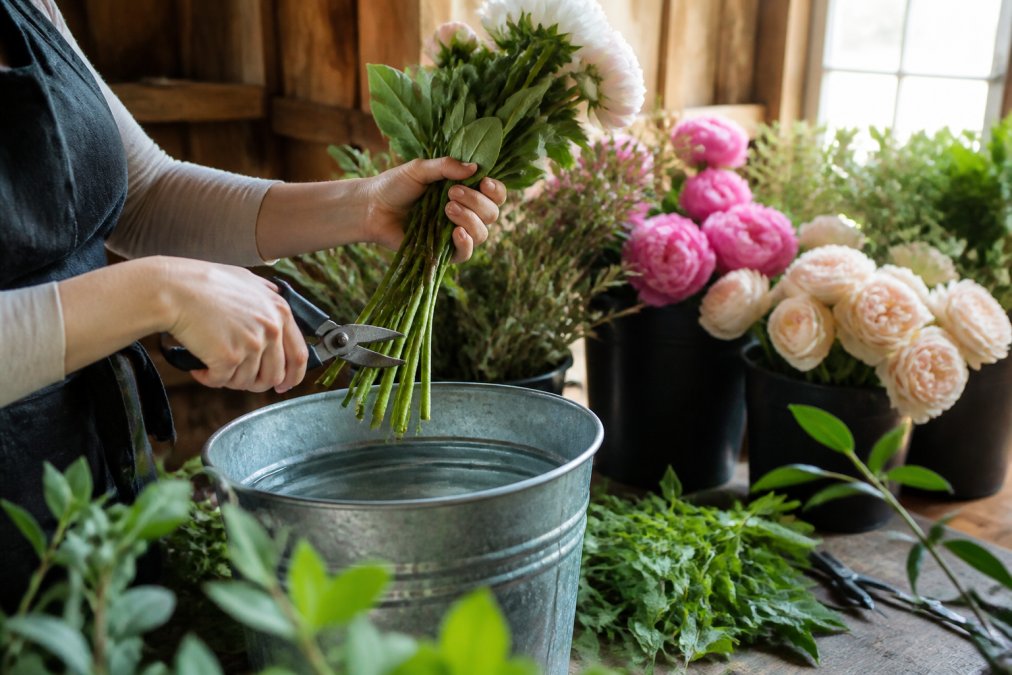
Processing flowers correctly upon arrival is the single most important factor in how long they last. When the box arrives, remove packaging, cut stems at a sharp angle, and place them in clean water with floral preservative within minutes.
Strip foliage below the waterline, since submerged leaves breed bacteria that clog stems. Cut each stem at a 45-degree angle with a sharp knife or pruner, never dull scissors, which crush vascular tissue (extension.psu.edu). Place stems in deep, lukewarm water with preservative and let them hydrate for at least two hours.
Temperature management after arrival is critical. Store flowers in a cool space between 34 and 38 degrees Fahrenheit when possible. If you lack a floral cooler, a basement or air-conditioned room works, but keep flowers away from ripening fruit, which emits ethylene gas that causes premature wilting.
For wilted flowers, "recutting and deep soaking" often revives them. Recut stems at a sharp angle, then submerge the entire stem up to the flower head in warm water for several hours. This restores turgidity to dehydrated stems, though it will not fix flowers harvested too mature or damaged by temperature extremes.
Your Floral Design Supply Checklist for Bulk Orders
Before a large purchase, build a supply checklist covering every stage from unboxing to final setup. You need clean buckets, sharp knives or pruners, floral preservative, and a cool, clean processing space.
Include design mechanics: floral foam or alternative frogs, tape, wire, and ribbon. Floral foam holds stems at precise angles but is not biodegradable; a foam-free approach using chicken wire and tape is gaining popularity.
Think in terms of a balanced recipe: focal flowers for visual weight, filler to soften, and foliage for texture. A common ratio is 60 percent focal, 25 percent filler, and 15 percent foliage (safnow.org).
| Supply Category | Items Needed | Purpose |
|---|---|---|
| Processing Tools | Clean buckets, floral knives, preservative | Hydration and stem preparation |
| Design Mechanics | Floral foam or frogs, tape, wire | Structural support for arrangements |
| Flower Recipe | Focal, filler, foliage varieties | Visual balance and fullness |
| Finishing Supplies | Ribbon, pins, spray sealant | Professional presentation |
Sustainability is a deciding factor for many florists. Imported blooms carry a significant carbon footprint, while local, farm-direct flowers support regional agriculture. Ask suppliers about growing practices, pesticide use, and waste handling.
For damaged shipments, document the condition with photos within hours of arrival and contact your supplier immediately to request a credit or replacement.
Choosing wholesale flowers is ultimately about building relationships with suppliers who share your standards for freshness, quality, and sustainability. Whether sourcing for a weekly arrangement or a 200-guest wedding, the principles remain the same: know your varieties, respect the cold chain, process with discipline, and plan your mechanics before the stems arrive.
Charmed Valley Farm offers wholesale and bucket programs for florists and DIY event hosts who value farm-direct freshness, with flowers cut to order and delivered at their peak. Our team works with you on variety selection, harvest timing, and volume planning. Get started with Charmed Valley Farm and bring the beauty of farm-grown flowers to your next creation.
Frequently Asked Questions
Do I need a license to buy wholesale flowers?
Most traditional floral wholesalers require a resale certificate or business license to open a trade account. Farm-direct growers like Charmed Valley Farm often have more flexible bucket programs for DIY event hosts. Ask about their specific requirements when you request a quote. Having your business license ready may speed up the process and unlock wholesale pricing.
How can I extend the vase life of wholesale flowers after delivery?
Start by processing flowers immediately upon arrival. Recut stems at a 45-degree angle and place them in clean buckets with fresh water and floral preservative. Remove any foliage that would sit below the waterline. Keep blooms in a cool, dark space, ideally between 34-38°F, for at least four hours to hydrate before arranging.
This article was written using GrandRanker