
Quick Summary
To preserve homemade skincare, first check whether the product contains water, since water lets bacteria, yeast and mold grow. Water-based products need a broad-spectrum preservative used at the supplier's exact rate, plus refrigeration. Oil-based products mainly need protection from air, light and heat.
- Water-based products carry the highest contamination risk and need a broad-spectrum preservative.
- Measure preservatives by weight with a digital scale and follow the supplier's use rate exactly.
- Oil-based products face oxidation more than microbial growth, so store them cool, dark and sealed.
- Sanitize tools, containers and surfaces before mixing, and use distilled or boiled water.
- Smell and sight checks miss some contamination, so keep batches small and use them within a conservative window.
Table of Contents
- When Your Homemade Skincare Product Needs a Preservative
- Water-Based Versus Oil-Based Products: Why the Formula Decides Your Approach
- Natural Preservatives for Water-Based Products and What They Can Actually Do
- Natural Preservatives for Oil-Based Products and Their Limits
- Best Preservatives for Skin Care Products: Choosing a Broad-Spectrum System
- Sanitizing Tools, Containers and Work Surfaces Before You Mix
- How Long Homemade Skincare Products Last and How to Confirm It
- Ordering a Preserved Serum or Toner Instead of Mixing Your Own
- Frequently Asked Questions
When Your Homemade Skincare Product Needs a Preservative
Last Updated: November 4, 2026
Water is the reason most homemade skincare needs a preservative. Any formula that contains water can grow bacteria, yeast or mold, and a kitchen rarely keeps those out. Whether you need to preserve homemade skincare depends mostly on what your product contains and how you plan to use it.
Start by asking one question: does your product contain water? Toners, hydrosols, gels and creams almost always do. Pure oil blends and anhydrous balms usually don't. Water gives microbes what they need to multiply, so water-based products carry the highest risk.
Cosmetics don't have to be sterile under U.S. rules, but they must not contain harmful microorganisms (FDA fact sheet on small businesses and homemade cosmetics). That makes contamination control your job, not an optional extra.
Use this quick check before you mix:
- Contains water? Add a broad-spectrum preservative.
- Anhydrous (no water)? A preservative may not be needed, but oxidation can still spoil it.
- Shared with others or used with wet fingers? Preserve it, even if it's oil-based.
- Plan to keep it past a week or two? Preserve it.
Without preservation, a water-based product in the refrigerator may not stay safe for long. Your product probably needs a preservative if you want it to last longer than a short period.
Water-Based Versus Oil-Based Products: Why the Formula Decides Your Approach
The formula decides your approach more than any recipe does. A water-based toner and an oil-based serum face very different risks, so when you preserve homemade skincare, each one needs different protection.
Water-based products are the high-risk group. Microbes need moisture to grow, and a toner full of water gives them plenty. Use a broad-spectrum preservative and keep the product cold.
Oil-based products face a different problem. Oil keeps microbes from growing well, but it does not stop spoilage. Oils go rancid when exposed to air and light, and that changes smell and effectiveness long before any bacteria appear.
Watch out: Adding a little water to an oil product, or dipping wet fingers into it, can bring microbes into a product that seemed safe.
The practical rule is simple:
- Water-based: preserve it and refrigerate it
- Oil-based: protect it from light, heat and air, and keep it dry
- Mixed (emulsions): treat it as water-based
Natural Preservatives for Water-Based Products and What They Can Actually Do
Many people look for natural preservatives first. The honest answer is that most natural options work less well than synthetic broad-spectrum systems, and some offer little real protection.
Common natural choices include grapefruit seed extract, honey and various essential oils. A product in a bathroom cabinet faces repeated contamination from fingers and air, and lab results don't always carry over to a jar you open every morning.
Keep your expectations realistic:
- Natural ingredients may slow some growth but rarely guarantee protection
- Essential oils can irritate sensitive or mature skin
- Honey adds water activity and sugar, which can feed microbes
If you choose a natural approach, keep the batch small, refrigerate it, and use it within days. Most homemade water-based products stay safest when you make only what you can use quickly.
Natural Preservatives for Oil-Based Products and Their Limits
Oil products call for a different strategy. Because oil doesn't support microbial growth well, the main threat is oxidation, not contamination.
Antioxidants such as vitamin E (tocopherol) are often used to help slow rancidity, which is a separate job from preventing microbial growth. Store the product in a dark, cool place, and keep it sealed.
Watch the limits here. Vitamin E slows oxidation but does not prevent microbial contamination in a product that gets wet. If you add water or use the product with damp hands, the protection disappears.
This is why an oil product can stay usable for a while and then turn quickly once it's exposed to water.
Best Preservatives for Skin Care Products: Choosing a Broad-Spectrum System
If your product contains water, a broad-spectrum preservative system gives you the most reliable protection. "Broad-spectrum" means the preservative works against bacteria, yeast and mold, not just one type. The harder question is which system fits your formula.
Start with the formulation type, then narrow by pH and processing conditions. The table below is a practical starting point, not a substitute for the supplier's instructions.
| Product type | Typical pH range | Preservative considerations |
|---|---|---|
| Toners, hydrosols, sprays | 4.0-6.0 | Water-thin formulas need a preservative that stays in the water phase; check solubility and odor |
| Gels (carbomer or xanthan) | 4.5-6.5 | Some preservatives bind to thickeners or lose activity in high-viscosity systems; confirm compatibility |
| Lotions and creams (emulsions) | 4.5-6.5 | Needs partitioning between water and oil phases; check whether the supplier recommends adding to the water phase or cool-down |
| Cleansers and scrubs | 4.5-6.5 | Rinse-off products still grow microbes between uses; watch for preservative deactivation by surfactants |
| Anhydrous balms and salves | Not applicable | No water means no microbial growth; focus on antioxidants instead |
When you compare options, look for:
- Broad-spectrum coverage: Works against bacteria, yeast and mold
- Use rate: Follow the manufacturer's percentage by weight exactly
- Compatibility: Works at your product's pH and with your other ingredients
- Solubility: Disperses in the phase where it needs to work
- Heat tolerance: Survives the temperature at which you add it
- Documentation: Clear instructions and safety data from the supplier
Every preservative has a specific use rate, and using too little leaves the product unprotected while using too much can irritate skin. Measure by weight with a digital scale, not by guesswork. Many systems also have a narrow effective pH window, so check the supplier's guidance for your formula before you commit.
Watch out: A preservative that works at pH 5 may lose most of its activity at pH 7, so test your finished product's pH with strips or a meter before you assume the preservative is doing its job.
If you are weighing natural versus synthetic options, keep the same framework. Some natural systems have narrower pH ranges, stronger odors, or lower heat tolerance, and those limits matter more than the label. The right choice is the one that matches your formula, not the one with the best marketing.
Sanitizing Tools, Containers and Work Surfaces Before You Mix
Even the best preservative can't fix a dirty workspace. For a related homemade recipe to try these hygiene steps with, see DIY homemade flower food recipes that actually work. Clean every tool, container and surface before you start.
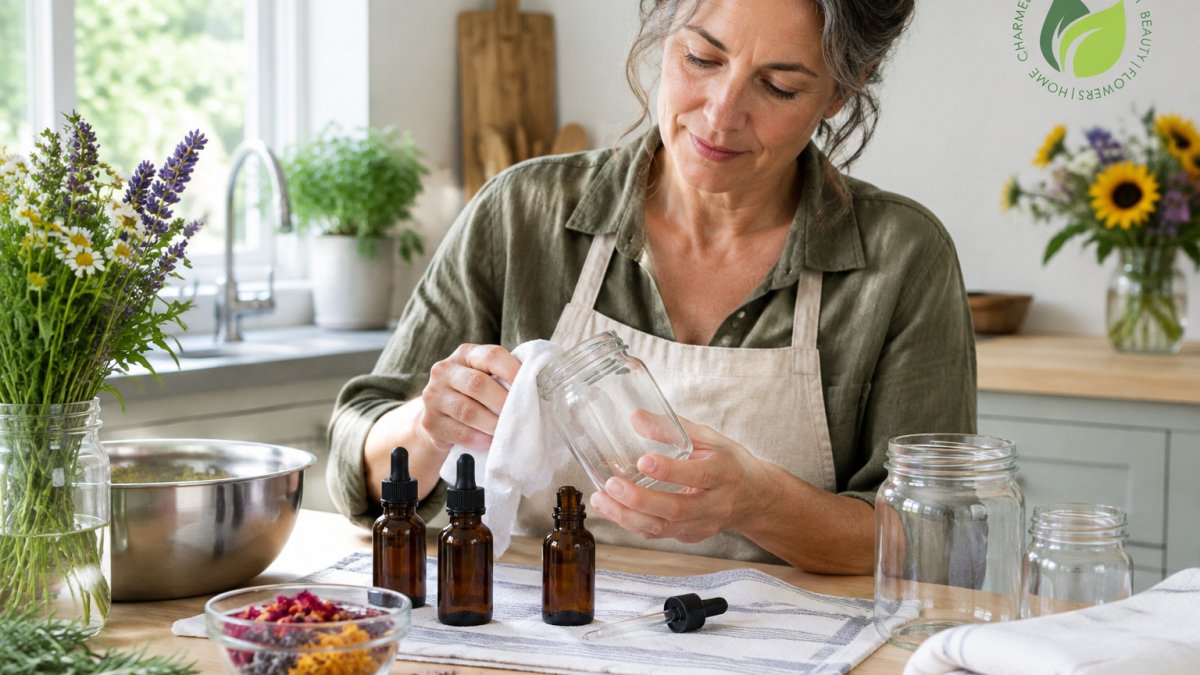
Here's a simple routine:
- Wash your hands, then clean the counter with soap and water.
- Wash jars, bottles, droppers and spoons with hot, soapy water.
- Rinse well and let everything air dry on a clean towel.
- Wipe tools and containers with isopropyl alcohol.
- Let the alcohol evaporate fully before you add ingredients.
Use distilled or boiled water rather than tap water, since tap water carries microbes that can seed your batch. Work quickly once you start, and keep lids on between steps.
A clean workspace matters most in the first few minutes, so don't skip the prep.
How Long Homemade Skincare Products Last and How to Confirm It
Shelf life depends on the formula, the preservative and how you store and use the product. Unpreserved water-based products may last only a short time in the refrigerator. A properly preserved product can last longer, but the exact time depends on your recipe, your hygiene during making, and how the product is used after opening.
Most home makers rely on sight and smell, but those checks have real limits. To see how long fresh ingredients remain usable, read how long fresh skincare ingredients last. A product can look and smell fine while containing harmful microorganisms, and rancid oil can smell off before any microbial problem appears.
A more reliable home process combines observation with record keeping:
- Date you made the batch
- Preservative and use rate
- pH of the finished product
- Storage location and temperature
- Any changes in color, smell or texture
- Date you first opened the product and how it was used
Discard any product that smells off, changes color or feels slimy. If you see mold, throw it out right away. When in doubt, throw it out.
Professional validation works differently. Stability testing holds samples at controlled temperatures and checks for separation, pH drift and texture changes.
Watch out: A product that passes a smell test after three months is not proof of safety; without challenge testing, the only reliable signal is that you have not exceeded a conservative use period.
For the best results, make smaller batches and keep them cold. If you plan to sell or share products, professional testing and labeling obligations apply, and home observation is not a substitute for them.
Ordering a Preserved Serum or Toner Instead of Mixing Your Own
If mixing your own preserved products feels like too much work, you can order ready-made options instead. Find a ready-made preserved botanical serum with the ingredients listed on the page. Our Flower Oil Face Serum is a $45.00 botanical serum made with organic, chemical-free ingredients, and it comes in a 1 oz bottle. Its listing notes that it is preservative-free and best used within 12 months of purchase, so keep it in a cool, dark place.

Prefer a toner? A finished shelf-stable toner is listed on its own page. Our Flower Water Face Toner is also $45.00 and comes in a 3.4 oz bottle. Its listing also says it is preservative-free, so store it away from direct sunlight.

If you want to learn more about ordering botanical skincare online, read our guide on order organic botanical skincare online. Explore our Flower Face Skincare collection to find the right fit for your routine.
Frequently Asked Questions
What is the best preservative for skin care products?
There is no single best preservative for every formula. A broad-spectrum preservative that works across bacteria, yeast and mold is the usual target, and the right choice depends on whether the product is water-based or oil-based and what its pH is. Many commercial preservatives must be used at a specified percentage by weight, so a measured use rate matters as much as the ingredient name. Natural options exist, but they often need more careful formulation and tighter storage to perform well. Always confirm compatibility and test the finished batch before relying on it for daily use.
Can you make skincare without preservatives?
You can, but any product containing water is at real risk of microbial growth once it is opened and touched. Preservative-free products such as some oils or anhydrous formulas carry lower risk, but they still need clean tools, clean containers and careful storage. Most preservative-free products, including the Flower Oil Face Serum and Flower Water Face Toner from Charmed Valley Farm, are labeled with a 12-month shelf life for this reason. Shorter storage windows are the trade-off for avoiding preservatives entirely.
How long do homemade skincare products last?
Unpreserved homemade products stored in a refrigerator may remain safe for only a short time. Water-based products with a broad-spectrum preservative system at a verified use rate can last considerably longer, but that is only true if the formula was tested and the batch was made with clean equipment. Storing products away from heat, humidity and light also extends their useful life. When in doubt, discard the batch rather than guess.
Do oil-based skincare products need a preservative?
Oil-based products are less prone to bacterial growth than water-based ones because they contain little or no free water. However, oils can still oxidize and go rancid, and contamination can enter through fingers and droppers during use. Antioxidants such as vitamin E are often used to help slow rancidity, which is a different problem from microbial spoilage. The Flower Oil Face Serum is cold-pressed and kept in a cool, dark place to protect its oils, and its listing notes it is best used within 12 months of purchase.
