Last Updated: November 4, 2026
Quick Summary
To add native wildflowers to professional bouquets, choose strong-stemmed, well-formed species, condition them carefully, and pair them with focal flowers and foliage in layers. Use only one or two native types per design, and source cultivated stems rather than foraging wild plants.
- Choose firm stems and open or clustered blooms that read well from a distance.
- Cut at an angle in the cool morning and place stems in clean water right away.
- Black-eyed Susan, purple coneflower, butterfly weed and yarrow last 5 to 7 days in a vase.
- Plan around local bloom windows and book native stems weeks or months ahead.
- Source cultivated natives from a reliable grower rather than wild-harvesting for professional work.
Table of Contents
- Why Native Wildflowers Belong in Professional Bouquets
- What You'll Need Before You Start
- Step 1: Choose the Best Native Wildflowers for Bouquets
- Step 2: Harvest and Condition Stems for Longer Vase Life
- Step 3: Pair Native Wildflowers With Foliage and Focal Flowers
- Step 4: Build the Arrangement for Texture, Height and Color
- Common Mistakes to Avoid When Using Native Wildflowers
- Booking Native Wildflowers From Charmed Valley Farm for Your Next Design
- Frequently Asked Questions
Native wildflowers have moved from the garden's edge into the professional floral studio. If you are a florist, farm, or DIY event host in Northern Michigan, you may wonder whether they can hold their own next to roses and ranunculus. They can. Native wildflowers bring a wild, airy look, support local pollinators, and tell a story of place no imported bloom can match.
Why Native Wildflowers Belong in Professional Bouquets
Native wildflowers can belong in professional bouquets because they add texture, movement, and a sense of place. Their loose, open forms suit modern and garden-style designs alike.
There is an ecological reason too. Research published in Springer in 2026 found that pollinator abundance and diversity were 2 to 3 times higher in native plant-based communities than in non-native ones Springer 2026 study on native-based landscapes and pollinators.
Native flowers are also gaining ground in the trade. Industry reporting shows that a growing number of professional growers and florists are exploring native plants as design elements in their studios and on their farms FloralDaily report on native plants as floral design elements.
One or two native stems in an otherwise classic arrangement can change the whole feel of it.
What You'll Need Before You Start
Before you build a bouquet with native wildflowers, gather the right tools and materials. Good prep makes the work faster and the flowers last longer.
- Sharp floral snips or a clean knife for stems
- A clean bucket of cool water, filled before you cut
- Floral preservative, if you have it
Keep your workspace clean. Dirty tools and cloudy water shorten vase life quickly.
Step 1: Choose the Best Native Wildflowers for Bouquets
Start by choosing flowers with strong stems and a shape that holds up once cut.
Look for these qualities when you choose:
- Stem strength: Firm stems that stay upright in the vase
- Bloom form: Open, cup-shaped, or clustered blooms that read well from a distance
- Color range: Blooms that add contrast to your palette, not just more of the same
Mix natives with classic focal flowers rather than building an entire bouquet from wildflowers alone. A few strong native stems give a design character, while your focal flowers give it structure.
Because availability shifts through the season, plan a few reliable native options for each month you do weddings or events.
Step 2: Harvest and Condition Stems for Longer Vase Life
Harvesting and conditioning are where many designs succeed or fail. Cut stems early in the morning, when fully hydrated, and place them in water immediately. For native wildflowers, generic gardening advice is not enough; professional florists need species-specific protocols and realistic durability expectations, especially for event work where bouquets face heat, transport, and hours without water.
Post-Harvest Conditioning Protocol
Follow this sequence for stronger, longer-lasting stems:
- Cut at the right stage. Harvest when buds show color but are not fully open, unless the design calls for fully open blooms. For most native perennials, cut in the cool of the morning before the day's heat opens the blooms.
- Cut at an angle. A slanted cut gives more surface area for water uptake. Use a sharp, clean knife or snips; dull tools crush vascular tissue and block uptake.
- Strip lower leaves. Remove foliage that will sit below the waterline, since it rots and fouls the water. For natives with fine or fuzzy foliage, strip carefully to avoid tearing the stem.
- Place in clean water right away. Move stems to cool water within minutes of cutting. Cool water is generally preferred for the first hydration, which slows respiration and reduces shock.
- Hydrate in a cool, dark place. Let stems rest several hours before arranging, away from heat and drafts. A cool, humid, shaded space is ideal for conditioning stems.
- Use a preservative. Follow label directions for dosage. For natives prone to bacterial growth (such as those with milky sap), change the water and re-cut stems every 24 hours during conditioning.
Species-Specific Vase Life and Durability Metrics
Not all natives behave the same way in professional event conditions. These ranges reflect what most practitioners observe with properly conditioned stems held at cool temperatures; test each variety under your own conditions before relying on it for a paid event.
- High durability (5-7 days in vase, holds through transport): Black-eyed Susan (Rudbeckia hirta), purple coneflower (Echinacea purpurea), butterfly weed (Asclepias tuberosa), and yarrow (Achillea millefolium). These species have firm stems and tolerate heat and handling well.
- Moderate durability (3-5 days, best for local delivery): Wild bergamot (Monarda fistulosa), lanceleaf coreopsis (Coreopsis lanceolata), and blanket flower (Gaillardia). These are reliable but may drop petals or wilt under prolonged heat.
- Low durability (1-3 days, use sparingly or for immediate events): Woodland phlox (Phlox divaricata), Virginia bluebells (Mertensia virginica), and bloodroot (Sanguinaria canadensis). These are best for intimate, same-day designs or as accent stems that can be replaced.
Species with hollow stems or milky sap may need extra handling before arranging.
Watch out: Never let cut stems sit in warm water or a sunny car. For transport, keep bouquets in coolers or air-conditioned vehicles and avoid stacking them so stems are not crushed.
Transport and Event-Hold Considerations
Professional event work adds stress that garden arrangements never face. Build in these safeguards:
- Pre-chill the vehicle. If you are delivering in summer, run the air conditioning before loading bouquets and keep them out of direct sun.
- Use water sources during setup. Bring buckets or individual water picks for bouquets that will sit out for hours before the event.
- Plan for some loss. Even with careful conditioning, some native stems may not hold through a full event day. Order or harvest slightly more than you need, and designate backup stems for replacements.
Keep in mind that exotic flowers can produce more blooms per year than many natives, so plan for lower volume when you rely heavily on wildflowers NCBI/PMC research on exotic versus native flower production. That lower volume makes careful conditioning and realistic durability planning even more important for professional work.
The article gives these vase-life ranges for common native species, which you can test under your own conditions before a paid event.
| Durability tier | Example species | Expected vase life |
|---|---|---|
| High durability | Black-eyed Susan, purple coneflower, butterfly weed, yarrow | 5-7 days |
| Moderate durability | Wild bergamot, lanceleaf coreopsis, blanket flower | 3-5 days |
| Low durability | Woodland phlox, Virginia bluebells, bloodroot | 1-3 days |
Step 3: Pair Native Wildflowers With Foliage and Focal Flowers
Pairing is where a native wildflower stops being a single stem and becomes part of a composed design.
- Focal flowers give the arrangement its main shape and impact
- Native wildflowers add movement, texture, and an informal feel
- Foliage and filler tie everything together and fill gaps
Choose foliage with its own shape, such as grasses, ferns, or leafy stems; too-uniform foliage makes a bouquet look flat.
Use a simple rule: no more than one or two native wildflower types per design, unless you are doing a deliberately wild, meadow-style arrangement.
Step 4: Build the Arrangement for Texture, Height and Color
Build from the center outward, placing your tallest stems first. Set the height of your focal flowers, then add native wildflowers at varying lengths so the design has depth.
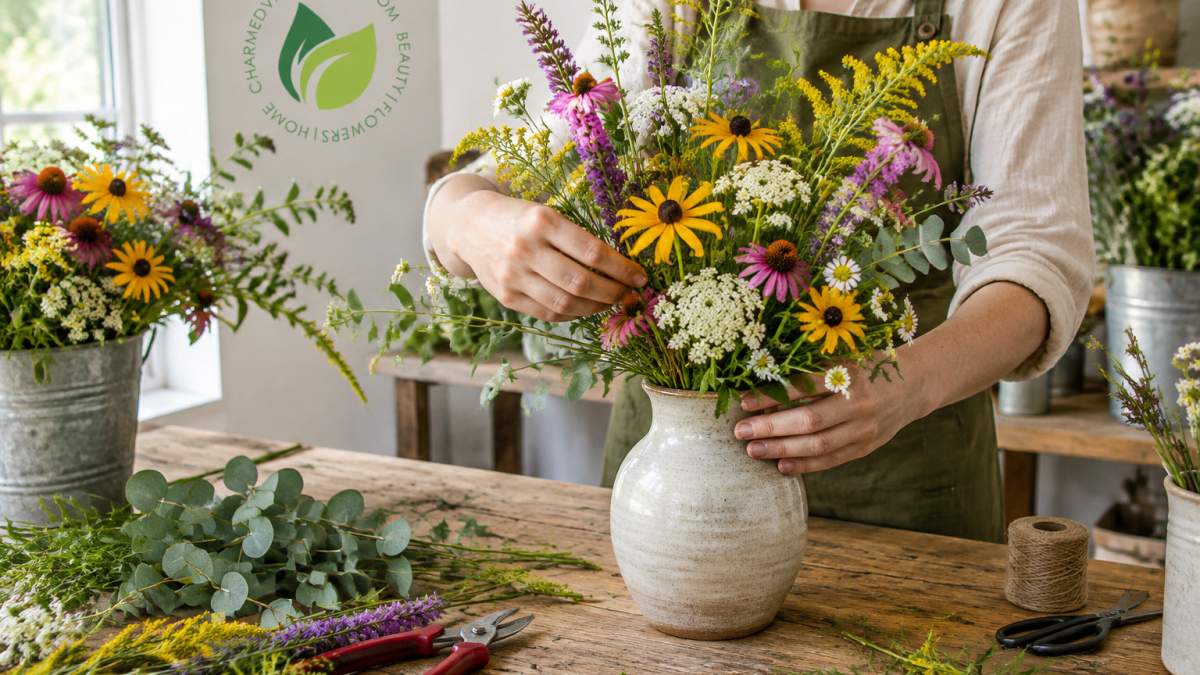
!A florist's hands arranging loose native wildflowers with contrasting foliage in a ceramic vase on a wooden workbench in natural daylight
Pay attention to three things as you work:
- Texture: Combine smooth petals with feathery foliage and grassy stems
- Height: Vary stem lengths so the bouquet has a clear silhouette
- Color: Repeat one or two colors through the design so it feels unified
Turn the arrangement as you go and check it from several angles. A bouquet that looks good from the front should still look balanced from the side.
Common Mistakes to Avoid When Using Native Wildflowers
Several mistakes come up again and again with native wildflowers. Avoiding them will save you time, product, and legal risk. The biggest mistake professionals make is treating native wildflowers like any other cut flower; they require different sourcing, handling, and compliance thinking.
Sourcing and Supply Chain Mistakes
- Assuming you can forage for professional work. Wild-harvesting native plants without explicit permission can be restricted by law, and many native species are protected by state or federal rules. For a professional business, cultivated natives from a reliable farm are the only defensible sourcing choice. US Forest Service guidance on wildflower harvesting
- Not vetting your supplier. Ask your grower whether plants are seed-grown or wild-collected, whether they use neonicotinoids (which harm pollinators), and how they handle post-harvest conditioning. A supplier who cannot answer these questions is not a professional-grade source.
- Ordering too late. Native perennials have narrow bloom windows. Unlike imported roses, you cannot call a wholesaler and get more next week. Build relationships with local native growers and book your stems weeks or months in advance, especially for peak wedding season.
Design and Handling Mistakes
- Skipping the conditioning step. Rushing from harvest to arrangement shortens vase life. Natives need the full hydration and cooling protocol described above.
- Overcrowding the vase. Too many stems block water uptake and crowd the design. Give stems room in the vase so water can move through them freely.
- Using dirty containers. Bacteria clouds the water and speeds decay. Sanitize buckets and vases between uses, especially with species prone to bacterial stem blockage.
Legal and Ethical Harvesting Guidelines
The distinction between wild-harvested and farm-grown native flowers matters for both legality and sustainability. Wild-harvested stems may be collected without regard for plant populations, and collection can be restricted by law. Cultivated natives allow growers to manage harvest timing and stem quality. For professional florists, the safe and ethical choice is to source from cultivated farms and ask suppliers about their growing practices.
Booking Native Wildflowers From Charmed Valley Farm for Your Next Design
If you want consistent, high-quality native wildflowers for professional work, Charmed Valley Farm can help. Charmed Valley Farm offers cut flowers and bucket programs designed for florists and DIY event hosts, and you can explore our Events collection to see what fits your schedule.
A bouquet is only as good as its freshness, which is why careful harvesting and conditioning matter. If you want to learn more about how to arrange flowers like a professional florist, our team can point you in the right direction.
Plan ahead, start with a few strong native stems, and build from there. Your next design can be the one that makes a client say, "I have never seen flowers like this before."
Frequently Asked Questions
Which native wildflowers are best for professional floral arrangements?
Choose native wildflowers with sturdy stems and a reasonable vase life, such as coneflowers, yarrow and bee balm, which hold up well once conditioned. Stems that stay upright after cutting make arranging easier and reduce waste. Test a small batch in your own studio before committing to a full order. Quantities, varieties and delivery timing depend on the season, so check current availability and pricing directly with Charmed Valley Farm for a quote.
How do you condition native wildflowers for longer vase life?
Cut stems in the cool morning, make a fresh angled cut under water, strip lower leaves and place stems in clean water with flower food as soon as possible. Keep buckets cool and out of direct sun, and recut stems every couple of days. Woody or milky stems often need extra time in a deep conditioning bath before arranging. Consistent conditioning is what extends vase life most.
Are there legal restrictions on harvesting native wildflowers for commercial use?
Yes. Wildflowers growing on public land are generally protected, and foraging them can be restricted or prohibited by the land manager, including the U.S. Forest Service and state agencies. Some species are also protected by law. Sourcing from a cultivated grower avoids these restrictions and protects wild populations, which is why many professional florists choose cultivated natives.
What are the best native foliage options to pair with wildflowers?
Native grasses, sedges, ferns and berried branches add texture without competing with bloom color. They also tend to last well in arrangements. Combining a few foliage types with your wildflowers creates depth and movement in the finished piece. Ask your supplier which foliage is ready to use for your event date.
