
Quick Summary
To choose the right flower CSA, compare each farm's cost per bouquet, season length, and pickup options, then confirm the farm grows its own flowers. Check refund terms, missed-pickup rules, and whether the bloom mix suits your tastes and schedule.
- Divide the total season price by the number of pickups to get cost per bouquet.
- Check cost per stem as well, since bouquet sizes differ between farms.
- Confirm in writing how missed pickups, vacation weeks, and cancellations are handled.
- Ask whether all flowers are grown on the farm rather than bought wholesale.
- Compare on-farm pickup, drop-off points, and home delivery against your own routine.
Table of Contents
- What a Flower CSA Is and How It Differs From a Bouquet Subscription
- Comparing Flower CSA Cost and Value
- Checking Flower CSA Season Length and Bloom Availability
- Reviewing Flower CSA Bouquet Examples, Frequency and Pickup Options
- Questions to Ask a Flower Farmer Before You Join
- Matching Flower Preferences, Refund Terms and Schedule Fit
- Signing Up for Your First Flower Share
- Frequently Asked Questions
What a Flower CSA Is and How It Differs From a Bouquet Subscription
A flower CSA, short for community-supported agriculture, is a membership where you buy a share of a local farm's seasonal flower harvest before the season begins. Members typically pick up fresh-cut bouquets on a set schedule. The farm gets upfront money to plan and plant, and you get fresh, locally grown flowers.
A bouquet subscription is usually a shop-driven service. A florist or online retailer assembles arrangements, often from wholesale stock that may have traveled a long way. Many subscriptions let you choose a plan and skip deliveries, but the flowers may come from anywhere.
The biggest practical difference is who grows the flowers and how much say you have in the mix. In a CSA, the farm decides what to plant, and your bouquets reflect the season. In a subscription, the retailer usually controls the selection and sourcing.
Watch out: A farm that calls itself a CSA but sells pre-bought wholesale stock may not be growing what it sells. Ask whether the flowers are grown on the farm before you commit.
Comparing Flower CSA Cost and Value
Flower CSA cost varies widely because farms set their own rates based on share size, season length, and delivery method. Rather than comparing sticker prices across farms, normalize every program to a cost-per-bouquet figure so you are comparing like with like.
The basic calculation. Divide the total season price by the number of pickups or deliveries. A $300 share with 15 pickups works out to $20 per bouquet. Run the same math on every farm on your shortlist before you judge any of them expensive or cheap.
Adjust for bouquet size. A $20 bouquet of 10 stems and a $20 bouquet of 25 stems are not the same value. Ask each farm for a typical stem count or a photo from a past season, then calculate cost per stem as a secondary check.
Adjust for season length. A 10-week share and a 20-week share at the same total price are very different commitments. Compare cost per week as well as cost per bouquet, because a longer season spreads your upfront payment over more flowers and usually lowers the per-bouquet cost.
Add delivery and pickup costs. On-farm pickup is typically included in the share price. Drop-off points and home delivery may carry a surcharge, and driving to a distant pickup point has a real cost in fuel and time. Add any delivery fee to the total before dividing, and estimate your round-trip travel to a pickup site so the convenience comparison is honest.
Benchmark against retail. Compare your per-bouquet figure with what a similar arrangement costs at a florist or grocery store in your area. For a wholesale benchmark, see wholesale flower pricing for florists. Compare arrangements of similar size so the comparison is fair.
Value beyond the receipt. Variety matters because you may receive blooms you would not normally buy. Supporting a local farm matters to many members. None of these show up in a per-bouquet number, so weigh them separately rather than letting a small price difference decide for you.
Watch out: A CSA bouquet may look different each week. If you want a consistent look and a predictable stem count, a CSA may feel less reliable than a florist arrangement, and that unpredictability should factor into whether the price feels worth it.
The article suggests normalizing each program to a cost-per-bouquet figure, so the main options compare as follows.
| Factor | What to check | Why it matters |
|---|---|---|
| Cost per bouquet | Total season price ÷ number of pickups | Compares farms on like terms |
| Cost per stem | Price ÷ typical stem count | Checks true bouquet value |
| Cost per week | Total price ÷ season weeks | Longer seasons often lower per-bouquet cost |
| Delivery fee | Added to total before dividing | Changes the real price |
| Travel to pickup | Round-trip fuel and time | Affects convenience |
| Retail benchmark | Similar arrangement at local florist | Shows whether the price is fair |
Checking Flower CSA Season Length and Bloom Availability
Most flower CSAs run through the growing season, which in Northern Michigan generally falls between late spring and early fall. Use the month-by-month bloom calendar to see which flowers are typically in bloom during each part of the season.
Ask the farm when its first and last pickups fall. Then ask which flowers bloom during each part of the season. Bloom timing shifts with weather, so ask the farm what is likely in each part of the season rather than expecting specific flowers.
Ask how any farm handles a poor season, including how it adjusts share contents or offers credits when weather damages blooms.
Reviewing Flower CSA Bouquet Examples, Frequency and Pickup Options
Bouquet frequency is one of the most important details to compare. Many flower CSAs offer weekly pickups, while others offer biweekly shares. Ask whether the farm allows you to switch frequency mid-season, and whether a skipped week can be credited.
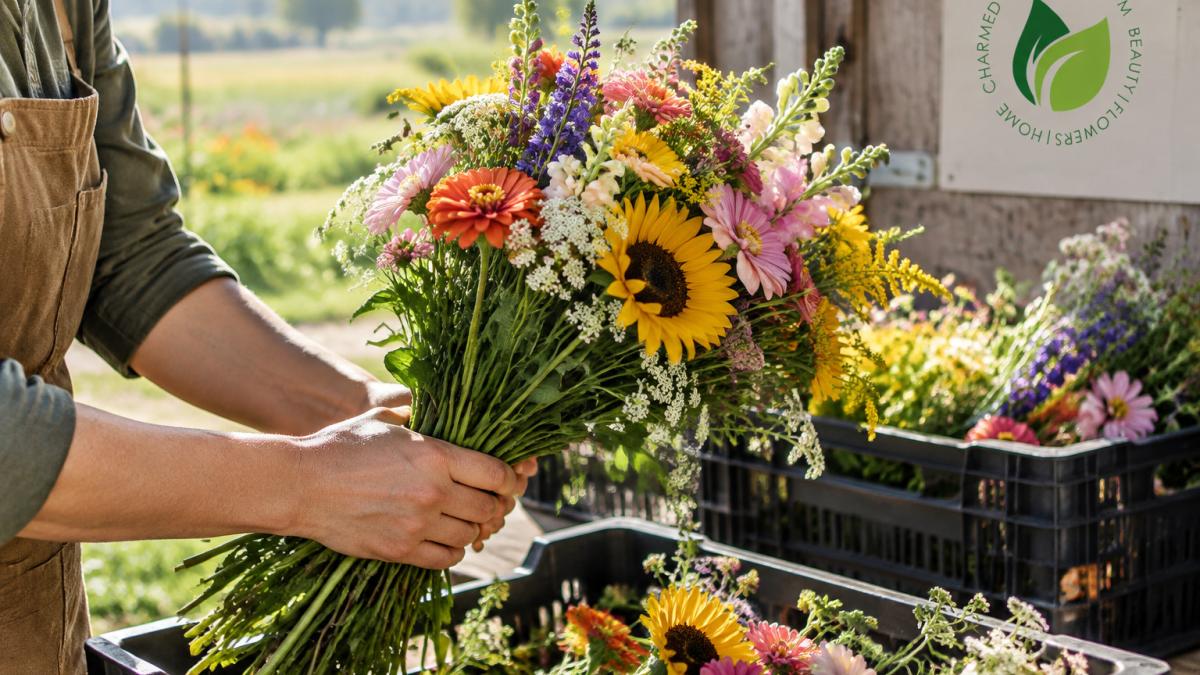
Bouquet size also varies from farm to farm. Ask for photos from past seasons and a typical stem count so you can judge how full the bouquets really are.
Pickup versus delivery. Programs commonly use one of several pickup or delivery models. Each carries different trade-offs.
- On-farm pickup lets you see the fields and often meet the grower, but it requires a round trip on a fixed day. It works best if the farm is close to your home or on your regular route.
- Drop-off points are usually more convenient but come with a narrow pickup window, often a few hours at a retail partner. If you cannot make that window, your flowers may be donated or lost.
- Home delivery is the most convenient but often carries a per-delivery fee and may require someone to be home or a cool spot for the box. Add the fee to your cost-per-bouquet math before comparing.
Schedule fit and missed pickups. Ask what happens if you miss a pickup, and whether a friend can collect your share or a substitution is allowed.
Vacation and pause policies. Ask whether you can pause your share for a vacation week and whether that week is credited, extended, or forfeited.
Accessibility. Check the pickup site itself: parking, stairs, walkability, and whether the window falls during hours you can realistically reach it. A convenient-sounding drop-off point across town can be a burden every week if parking is difficult or the window is short.
Watch out: Before you commit, confirm in writing how missed pickups, vacation weeks, and schedule changes are handled, because these terms decide whether a share fits your routine or becomes a weekly obligation.
Questions to Ask a Flower Farmer Before You Join
Before signing up, ask the farm a few direct questions. A good farmer will answer them plainly. To see how a flower farm CSA is run from the grower's side, read how to start a flower farm CSA from scratch.
- Are all flowers grown on this farm, or are some purchased from other growers?
- What is the expected length of the season, and what are the first and last pickup dates?
- How many stems or flowers are in a typical bouquet, and how often do pickups happen?
- What happens if the crop fails because of weather or disease?
- What are the refund and cancellation terms?
- Do you use pesticides or synthetic fertilizers?
- Where and when do I pick up my share, and what happens if I miss a pickup?
Pay attention to how the farmer answers. Clear, specific answers usually signal a well-run operation.
Matching Flower Preferences, Refund Terms and Schedule Fit
Start with your own flower preferences. Do you like bold, bright blooms, or soft, muted tones? Some people dislike strong scents, and some have allergies to particular plants. A CSA gives you less control over selection, so make sure the farm's typical crop mix suits you.
Read the refund and cancellation policy carefully. Look for answers to these questions:
- Can you cancel mid-season, and do you get money back?
- Is a missed pickup refunded or lost?
- Are credits offered if a bad season reduces the harvest?
Finally, check schedule fit. Consider your weekly routine, travel, and whether you will be home for pickups. If sustainability matters to you, see how farms are assessed in evaluating water usage in flower production. A share that looks good on paper can become a burden if it does not fit your life.
Watch out: Missing pickups is common. If your schedule is unpredictable, choose a farm that allows substitutions or delayed pickup.
Signing Up for Your First Flower Share
Once you have compared farms, narrow your list to the one that best fits your budget, schedule, and flower preferences. Then take these steps:
- Confirm the season dates, pickup location, and share size.
- Read the full membership agreement, including refund terms.
- Sign up early, since many farms cap membership numbers.
- Mark your pickup dates on your calendar.
- Plan to use or store your flowers right after each pickup.
For first-time members, start with a shorter or smaller share to learn how the program works. You can always expand next season once you know how the farm operates.
To learn more about Charmed Valley Farm's offerings and membership details, visit Charmed Valley Farm's website and contact us for current pricing and availability.
Frequently Asked Questions
What is a flower CSA?
A flower CSA, or community supported agriculture program for flowers, is a membership in which you pay a farm upfront for a set number of seasonal bouquets. Members typically pick up or receive arrangements on a regular schedule during the growing season. Because the farm receives payment before harvest, it can plan planting and cash flow more easily. Members get locally grown cut flowers and usually learn which varieties the farm grows that season. Program details, including share sizes, pickup locations and bouquet frequency, vary by farm, so read each farm's policies before you sign up.
How do I know if a flower CSA is worth the flower CSA cost?
Start by dividing the total membership price by the number of bouquets to get a cost per bouquet, then compare that figure with what similar arrangements would cost at a florist or grocery store. Factor in pickup travel, the length of the season and whether the farm allows substitutions or pauses. Pricing depends on share size, number of weeks and location, so ask the farm for its current rates and what each share includes. Value also depends on how much you enjoy the flowers and how reliably the farm delivers on schedule.
How long does a flower CSA season last?
A flower CSA season usually runs for part of the growing year, often from late spring or early summer through early fall. Flower CSA season length varies by farm and climate, and bloom timing shifts with weather, so a farm may not offer the same varieties every week. Ask for the exact start and end dates, the number of weeks included and what happens if a frost or storm reduces the harvest.
What should I ask a flower farmer before joining a flower CSA?
Ask how often you will receive bouquets and whether the frequency is weekly or biweekly. Find out where and when pickup happens, whether delivery is available and what the refund and cancellation terms are. Ask how the farm handles weather losses or a poor season. Request examples of past flower CSA bouquet examples so you know what to expect in size and variety. A reputable farm will answer these questions directly and in writing.
