
Last Updated: October 30, 2026
Quick Summary
Organic essential oil is not automatically safe for your face, because organic describes how a plant was grown, not how the oil behaves on thin, reactive facial skin. Use it only at the right dilution for your skin type, and never apply undiluted oil to your face.
- The FDA has no regulations defining organic or natural for cosmetics.
- Never apply undiluted essential oil to your face; dilution is the key safety step.
- Match the dilution ratio to both the oil and your skin type, using the lower number when in doubt.
- Do a two-day patch test before committing to a full face of product.
- Skip cold-pressed citrus oils before sun exposure because of phototoxicity risk.
Table of Contents
- Why Organic Essential Oil Isn't Automatically Safe for Facial Skin
- How to Dilute Essential Oils for Skin Without Guessing
- The Essential Oil Patch Test Every Face Should Get First
- Essential Oils for Sensitive Skin: What to Try and What to Skip
- Recognizing Essential Oil Skin Irritation Before It Spreads
- What Organic Certification Does and Doesn't Tell You
- Who Should Talk to a Doctor Before Applying Oil to the Face
- Building a Flower-Based Facial Routine That Skips the Risk
- Frequently Asked Questions
Why Organic Essential Oil Isn't Automatically Safe for Facial Skin
Here's a hard truth: organic essential oil is not automatically safe for your face. The word "organic" tells you how a plant was grown. It says nothing about how that oil will behave on delicate facial skin.
At Charmed Valley Farm, we work with botanicals every day, and we still treat concentrated oils with respect. The FDA states plainly that it has no regulations defining "natural" or "organic" for cosmetics, and notes that cumin oil can be safe in food yet cause skin blistering (FDA guidance on aromatherapy and cosmetics).
Facial skin is thinner and more reactive than the skin on your body.
So is organic essential oil safe for face? Sometimes, at the right dilution, for the right person. For a closer look at the hidden irritants to watch for, see our guide to identifying hidden irritants in organic beauty products. Below, we'll show you exactly how to tell the difference.
How to Dilute Essential Oils for Skin Without Guessing
Dilution is the single most important safety step, and most people guess at it. Don't.
An essential oil dilution is the practice of mixing a small amount of concentrated oil into a carrier oil before it touches skin. Carrier oils are plain plant oils, like sunflower or jojoba, that spread the essential oil and slow absorption. For facial use, the carrier matters as much as the essential oil: choose a light, low-comedogenic carrier such as jojoba, sunflower, or squalane, and avoid heavy occlusives if you are acne-prone.
Never apply undiluted essential oil to your face. That is how irritation starts.
Face-Specific Dilution Ratios by Oil and Skin Type
Not every oil behaves the same way, so match the ratio to both the oil and your skin. The table below gives conservative facial ranges; when in doubt, use the lower number.
| Oil | Suggested Facial Dilution | Best For | Use Cautiously If |
|---|---|---|---|
| Lavender | 0.5-1% | Calming, normal skin | Very reactive skin |
| Roman chamomile | 0.5% | Sensitive, easily reddened skin | Ragweed allergy |
| Tea tree | 0.5% spot use | Occasional blemishes | Dry or eczema-prone skin |
| Rosemary | 1% max | Oily skin | Sensitive skin, pregnancy |
| Peppermint | Avoid on face, or 0.25% max | Cooling spot use only | Sensitive skin, rosacea |
| Cold-pressed citrus (bergamot, lemon, lime) | 0.5% and only in rinse-off or nighttime products | Not recommended for leave-on daytime facial use | Sun exposure, phototoxicity risk |
When to Use a Lower Concentration or Skip an Oil Entirely
Use the lowest end of the range, or skip the oil, if any of these apply:
The Essential Oil Patch Test Every Face Should Get First
An essential oil patch test is a small trial application that shows whether your skin reacts before you commit to a full face of product. It takes two days and costs nothing.
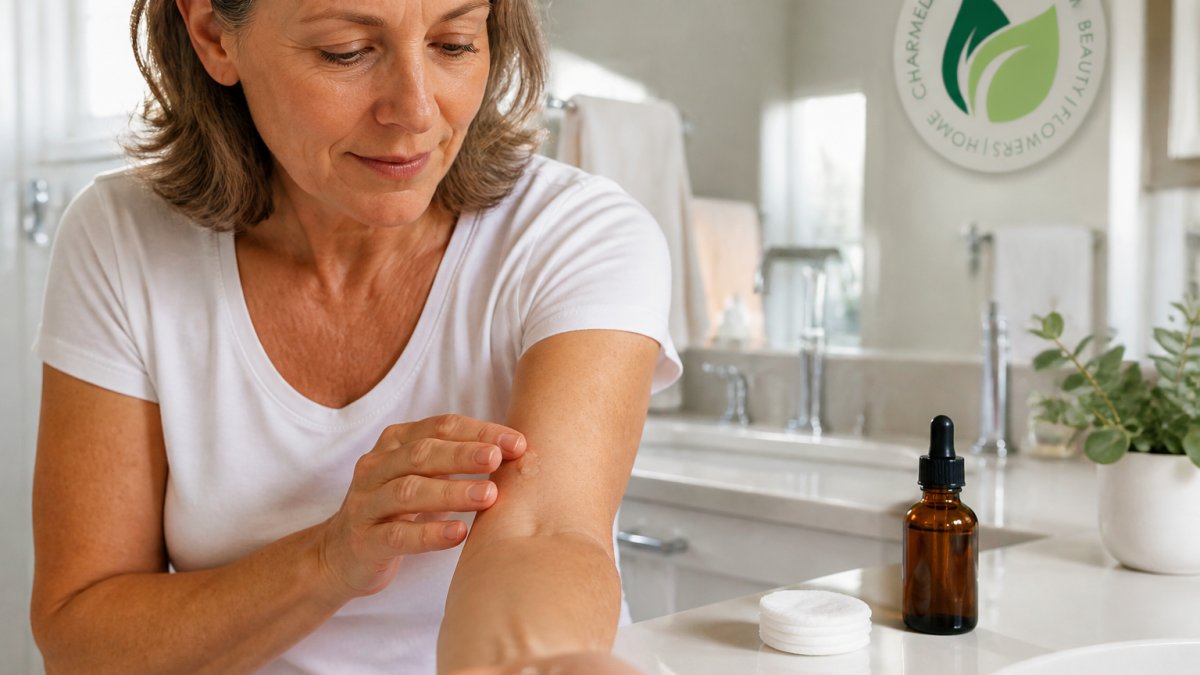
Stop at any sign of a reaction. A patch test won't catch every possible issue, but it catches most.
Essential Oils for Sensitive Skin: What to Try and What to Skip
If your skin is reactive, choose fewer oils and lower dilutions. That's the whole strategy. Once you know which oils to skip, you can follow an organic skincare routine for rosacea-prone skin.
Recognizing Essential Oil Skin Irritation Before It Spreads
Essential oil skin irritation usually starts small: a patch of redness, mild itching, or warmth. Catch it early and it fades. Ignore it and it can spread.
Watch for these signs:
What to Do After a Facial Reaction
If your face stings, burns, or breaks out after applying an essential oil, act quickly:
Eye Exposure and Other Urgent Situations
Essential oils near the eyes are a common accident. If oil gets into your eye:
Phototoxicity: When Sunlight Turns an Oil Against You
Some oils react with sunlight and burn skin that would otherwise be fine. This is called phototoxicity, and it is a real risk with cold-pressed citrus oils such as bergamot, lemon, lime, and bitter orange. The reaction can look like a sunburn that appears only where the oil was applied.
If you use a citrus oil, keep it off your face before sun exposure, or skip it entirely. If your skin is already sun-sensitive, our organic sunscreen options for sensitive skin are worth a look.
What Organic Certification Does and Doesn't Tell You
Here's the gap: the FDA doesn't define "organic" for cosmetics at all. A label can be meaningful and still tell you nothing about irritation risk or concentration. A 2025 review of essential oils in skin care found research is still ongoing on both benefits and safety (review of essential oil efficacy and safety in skin care).
So read labels for three things:
- The plant's botanical name, not just "lavender."
- Whether it's a blend or a single oil.
- Any dilution guidance on the bottle.
If you want a longer list of ingredients to question, see our guide to organic ingredients to avoid in skincare.
Who Should Talk to a Doctor Before Applying Oil to the Face
Some people should check with a doctor first before using facial oils.
Talk to a professional before facial oil use if you:
- Are pregnant or breastfeeding.
Building a Flower-Based Facial Routine That Skips the Risk
You can enjoy botanicals on your face without the guesswork. The trick is choosing products that are already formulated, diluted, and gentle. If you'd rather start from scratch, here's how to build a natural flower-based skincare routine.
At Charmed Valley Farm, our #Farm2Face line is built with care. The Flower Oil Face Serum ($45.00) uses organic, cold-pressed sunflower oil infused with rosehips, raspberry leaves, and rose geranium. It is made with no added chemicals or fillers. The Flower Face Duo ($85.00) pairs the serum with our Flower Water Face Toner, which carries traces of essential oils from lavender, clary sage, amaranth, yarrow, and honeysuckle. You can browse the full Flower Face Skincare collection to see what fits your routine.


That's the difference between raw oil and a finished product. One needs careful measuring. The other is ready to use.
Frequently Asked Questions
Are organic essential oils safer for facial skin than conventional ones?
Not necessarily. The FDA says it has no regulations defining natural or organic for cosmetics, so an organic label does not guarantee a product is gentle on your face. The FDA does not define natural or organic for cosmetics, so an organic label does not by itself establish how gentle a product is on your face.
How do you patch test an essential oil before using it on your face?
Dilute the oil to your intended facial concentration in a carrier oil, then apply a small amount to the inner forearm. Leave it uncovered for 24 to 48 hours and watch for redness, itching or swelling. If the area stays calm, repeat on a small patch behind the ear or along the jaw. Stop at the first sign of a reaction, wash the area with mild soap, and do not apply the oil again.
Can essential oils irritate sensitive or reactive skin?
Yes. Sensitive and reactive skin reacts to lower concentrations than other skin types, and repeated exposure can lead to sensitization, where a previously tolerated oil starts causing an itchy rash. A 2025 review notes that essential oils often have fewer side effects than synthetic ingredients, but that does not make them risk-free. Start at half your planned dilution, patch test first, and keep a single new oil in your routine at a time so you can identify the trigger.
What should you do if an essential oil causes a reaction on your face?
Stop using the oil immediately and wash your face with lukewarm water and a mild, fragrance-free cleanser. Skip other actives and essential oils until the redness and itching settle, and keep the area moisturized with a plain carrier oil or bland cream. If swelling, blistering, or a rash that spreads appears, contact a doctor. Note which oil and concentration caused it, since contact dermatitis can worsen with each repeat exposure.
Your face deserves better than a gamble on a pretty label. At Charmed Valley Farm, we formulate small-batch, chemical-free skincare built around organic botanicals, with no fillers and no guesswork. Explore the fan-favorite Flower Face line and give your skin something it can actually tolerate. Get started with Charmed Valley Farm and build a routine rooted in real, farm-to-face ingredients.
